In their recent paper “Contemporary Law and Economics,” Adam Chilton, Joshua Macey, and Mila Versteeg argue that LPE critics of the Law and Economics movement are attacking a straw man. The authors claim that although Law and Economics once stressed efficiency goals, which they defined as “wealth maximization,” contemporary practitioners simply endorse the use of modern empirical social science methods, primarily econometrics, to study law and legal institutions. The L&E movement has grown, they suggest, “by embracing and accepting critiques that were levied against it.” Indeed, contemporary Law and Economics, they maintain, routinely addresses concerns about equity and the dangers of concentrated power, the very problems that LPE critics claim Law and Economics overlooks or exacerbates.
This characterization of the field is unconvincing. Law and Economics scholars today may not openly defend free markets and limited government like the prior generation, but neither have they disavowed this history, nor have they come to terms with the many problems inherited from the L&E legacy.
L&E Textbooks & Kaldor-Hicks Efficiency
Paul Samuelson, Nobel Prize laureate and author of the most influential economics textbook of the twentieth century, once said, “I don’t care who writes a nation’s laws—or crafts its advanced treaties—if I can write its economic textbooks.” This is because textbooks exert profound influence on what lessons from an academic discipline become part of the consciousness of policymakers. So, to evaluate whether contemporary L&E no longer teaches that the goal of the law should be Kaldor-Hicks efficiency, we reviewed twelve major L&E textbooks:
- Richard A. Posner, Economic Analysis of Law (2014)
- Jeffrey Harrison & Jules Theeuwes, Law and Economics (2008)
- Werner Hirsch, Law and Economics: An Introductory Analysis (1999)
- Robin P. Malloy, Law and Economics: A Comparative Approach (1990)
- Daniel H. Cole & Peter Z. Grossman, Principles of Law and Economics (2005)
- Thomas J. Miceli, The Economic Approach to Law (2004)
- David D. Friedman, Price Theory: An Intermediate Text (1990)
- David D. Friedman, Law’s Order (2000)
- Robert Cooter & Thomas Ulen, Law and Economics (2004)
- David Barnes & Lynn Stout, Cases and Materials on Law and Economics (1992)
- A. Mitchell Polinsky, An Introduction to Law and Economics (2019)
- Mark Seidenfeld, Microeconomic Predicates to Law and Economics (1996)
Each of these textbooks presents Kaldor-Hicks (“K-H”) efficiency—in which a change is efficient so long as the gains to those who benefit outweigh the losses to those who are disadvantaged—as central and desirable to legal analysis. Many of these books imply that K-H is the only defensible criterion for public policy. It is true that a few textbooks state that there is a trade-off between K-H efficiency and distributional fairness or equity. But many of the texts add the additional caveat that equity should be handled via income taxes and not legal rules. For legal rules, those authors say that the law should use K-H efficiency as its only goal.
Kaldor-Hicks efficiency is ideological because, although it is presented as a neutral, objective standard, the criterion straightforwardly favors the rich and justifies the actions of large corporations. It does so by relying on “willingness to pay” as a standard, which is itself dependent on one’s ability to pay. Keeping preferences constant, the more income one has the more one is “willing to pay” (for a normal good), and this biases the analysis in favor of those with more income.
In adopting this approach, these L&E textbooks are inconsistent with modern welfare economics. One problem is that all the textbooks conflate Hicks’s contribution with Kaldor’s contribution. Kaldor’s “compensating variation” measure of value asks: assuming the change is adopted, what other change would be needed to recover the original level of utility? Hicks’s “equivalent variation” measure of value asks: assuming the change is not adopted, what other change would be needed to achieve what the new level of utility would have been had the change been adopted? To put this in the “willingness to pay” language common in these textbooks: if the proposed change is a gain to the agent, compensating variation is “willingness (and ability) to pay” (here “WATP” rather than “WTP” to highlight the “ability” part), and equivalent variation is “willingness to accept” (“WTA”). If the proposed change is a loss to the agent, equivalent variation is WATP and compensating variation is WTA. Among welfare economists, WATP and WTA are equally valid measures of value, and are linked: if $10 is an agent’s WATP to move from Policy A to Policy B, then -$10 is that agent’s WTA to move from B to A.
Unfortunately, WATP and WTA are not equal to each other in general. Empirically, WATP is generally less than WTA, which is unsurprising because WATP is constrained by income (or wealth) and WTA is not. The inequality between WATP and WTA raises serious consistency problems. None of the L&E textbooks teach students that WATP is in general not equal to WTA, even though their inequality, and the consistency problems it causes, is central in every welfare economics textbook. Cooter and Ulen’s textbook is the only L&E textbook that hints at the problems, stating that “There are both theoretical and empirical problems with this standard, but it is indispensable to applied welfare economics.” But Cooter and Ulen do not say what the problems are, let alone address them.
To explain just one of the many problems ignored by the L&E textbooks, consider: (1) a policy that would slightly inconvenience a sufficiently rich person but save a poor person’s life; or (2) a policy that would permit a sufficiently rich person to physically attack a poor person. The pro-poor Policy (1) would fail the Kaldor criterion (the rich person’s WTA being higher than the poor person’s WATP) but pass the Hicks criterion (the rich person’s WATP being less than the poor person’s WTA). The pro-rich Policy (2) would also fail the Kaldor criterion (the rich person’s WATP being less than the poor person’s WTA) and pass the Hicks criterion (the rich person’s WTA being more than the poor person’s WATP). In other words, once the Kaldor and Hicks criteria are distinguished, K-H decision-making can simply be incoherent.
Welfare economics textbooks (as well as our works here and here) discuss such conflicts between the Kaldor and Hicks Tests, and they discuss other serious problems as well: policy reversals (endorsing a move from Policy A to Policy B and also endorsing a move from Policy B to Policy A); identifying a move as being Potential Pareto although if the move is made, equilibrium prices adjust in a way that makes compensation impossible (the Broadway Paradox); and the Paradox of the Non-Neutral Numéraire. These problems led most welfare economists to abandon the Kaldor-Hicks approach several decades ago, but they are ignored by L&E textbooks.
Indeed, even Kaldor and Hicks, the originators of the approach, abandoned it. By 1975, three years after Hicks had won the Nobel Prize and more than 30 years after he formulated the Hicks criterion, Hicks cast doubt on the usefulness of the Potential Pareto Hicks test, as well as the notion of Pareto improvements. Kaldor, for his part, does not seem to have ever used the Kaldor criterion in his very long career after his original article in 1939. By 1955, Kaldor, in his book An Expenditure Tax, denied that there is any necessary equity-efficiency trade-off (discussed below), and he became a leading critic of neoclassical economics: “The main thesis of the book is therefore that there is no need to look upon the egalitarian or re-distributive objectives of progressive taxation as being necessarily in conflict with considerations of economic efficiency and progress.”
L&E and Distribution
Turning to the question of distribution, do L&E scholars, as Chilton, Macey, Versteeg claim, consider issues of inequality? The only article they cite in support of this claim is Jacob Golden and Zachary Liscow’s contribution to the symposium, which considers when departures from Kaplow and Shavell’s “double distortion” theory are justified. This theory states that even if the law should consider equity, it should do so only through income taxes, not legal rules. The logic is that redistribution by a legal rule causes two distortions: the first distortion is introducing incentives that undermine K-H efficiency in the activity regulated by the rule; the second is that income taxes on the rich reduce the incentives of the rich to work and create wealth.
One reason that the double distortion argument is flawed comes from the Theory of the Second Best, which shows that two distortions can be an improvement over one. For example, a polluting firm produces too much output relative to the social optimum, and a monopolist produces too little output relative to the social optimum, but in the case of a polluting monopolist these effects offset, always bringing output closer to the social optimum than if only the larger of the two distortions was present by itself (such as distortions of -1 and +10, with a total distortion of +9), and sometimes bringing output closer to the social optimum than if either of the two distortions was present by itself (such as distortions of -9 and +10, with a total distortion of +1). Or consider a situation with a monopsony buyer of labor, which depresses the wage below the competitive level; and a labor union, which would normally increase the wage above the competitive level. With the monopsonist and the union together, the wage distortions offset, as in the previous example.
A second problem with the double distortion argument is that there is simply no evidence that redistribution causes the rich to work less on average. In double distortion arguments, it is assumed that redistribution from the rich to the poor causes economic harm because the rich will exert less than optimal effort, instead choosing more leisure. Most modern work asserting a labor-leisure trade-off in the context of taxation stems from a famous paper by Nobel laureate James Mirrlees. But in that paper Mirrlees wrote, “I would also hesitate to apply the conclusions regarding individuals of high skill: for many of them, their work is, up to a point, quite attractive, and the supply of their labour may be rather inelastic (apart from the possibilities of migration).”
The empirical evidence is legion that there is no necessary equity-efficiency trade-off. For example, the 1950s–1970s in the United States were a period of low and falling inequality, yet the country experienced high growth rates compared to the 1980s to the present. We presented the following diagram in a working paper that forms the basis of the rest of this post, showing, for the United States, increasing inequality and decreasing economic growth over the last few decades:
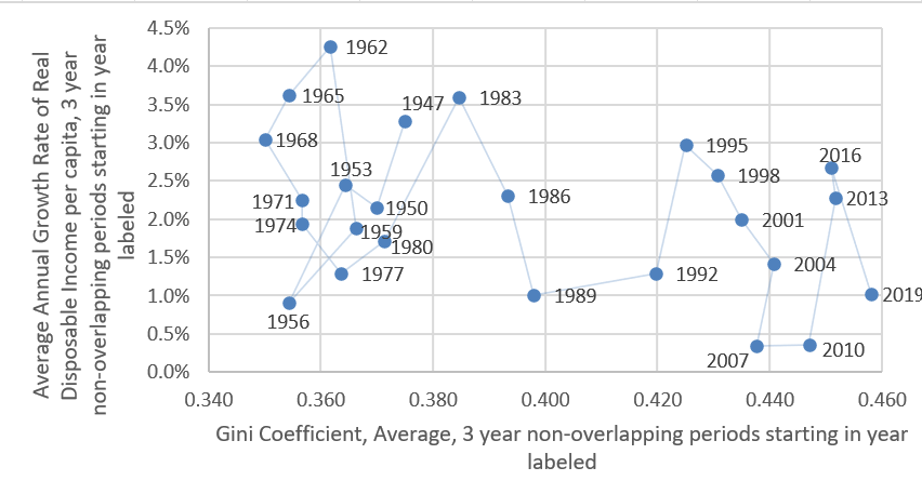
The claim that there is a tradeoff between equality and efficiency is plainly unsupported by this data. Greater inequality (higher Gini coefficients) has been associated with a lower growth rate, and the data is clearly divided into two eras, an earlier one with low inequality and high growth, and a more recent one with high inequality and low growth, with 1986–1991, the end of the Reagan administration and most of the George H.W. Bush administration, being the transition period.
Note that using these three-year periods, which operate to smooth the data, inequality increased or stayed constant from the period starting in 1968 to the period starting in 2004 and every period in between. To provide some summary statistics: the growth rate for the period 1947 to 1973—when the top 10% of the income distribution had a 10.61% share of total income—was 3.88%. In comparison, from 1980 to 2015 the top 10% garnered a 17.01% share of total income and the growth rate was 2.51%. As we have demonstrated in a prior work, labor productivity was also higher in the earlier period (2.36%) than the later period (1.18%). Total factor productivity displayed a similar historical pattern.
This pattern holds in many other countries as well. For example, in a recent OECD survey of both OECD and non-OECD countries, Federico Cingano finds that “inequality has a negative impact on economic growth,” writing: “[t]he impact of inequality on growth turns out to be sizeable…lowering inequality by 1 Gini point would translate in an increase in cumulative growth of .8 percentage points in the following 5 years.” Similarly, Jonathan Ostry, Andrew Berg, and Charalambos Tsangarides of the International Monetary Fund conducted a large cross-country study and found that “lower net inequality seems to drive faster and more durable growth for a given level of redistribution.” In general, there is a complementarity between equity and efficiency, not the tradeoff that economists widely accept.
As for why equity and efficiency are complementary, Cynamon and Fazzari assert that inequality causes growth instability through reductions in demand and increases in consumer debt. Another explanation is that higher wages create strong incentives for innovation and growth. This argument was made by economists as diverse as Karl Marx in the nineteenth century; John Hicks, H.J. Habakkuk, and Gerard Duménil & Dominique Lévy in the twentieth century; and R.C. Allen, Robert Gordon, and Lance Taylor & Özlem Ömer in the twenty-first century. For recent examples, David Hémous et al. found that “higher wages induce increased automation. In particular, raising the minimum wage increases automation innovation.” Amrita Nain and Yan Wang found that “larger minimum wage increases in a state are associated with a more positive change in automation patent applications by firms headquartered in that state.”
On an overall level, Jeffrey Sachs has argued that economic growth increases with equity-increasing spending on “universal provision of quality health care, childcare, pre-kindergarten schooling, and high-quality education from primary school through vocational or tertiary education.” Nobel laureate economist Joseph Stiglitz, in his book The Price of Inequality, describes the growth-killing effects of inequality. He argues that high incomes encourage rent seeking and political influence that can result in reduced government investment in innovation. The rich prevent regulation that can overcome market failures and curtail other critical social investments such as education and health. Inequality reduces social trust and cooperation, factors that are also fundamental to effective markets. At the level of the firm, inequality in wages can harm teamwork and efficiency.
In sum, L&E teaches, counter to the evidence, that redistribution decreases economic efficiency and growth. Redistribution should not be considered a distortion, but policy that improves human welfare without sacrificing growth. That does not mean that every redistributive policy should be adopted: the merit of each requires careful inquiry into the particulars of the situation, as Matthew Dimick’s book exemplifies.
***
For us, the Chilton, Macey, and Versteeg defense of “contemporary” L&E against the LPE critics is unavailing. The way most students (future policy makers) learn about L&E is through its textbooks, and these textbooks continue to present Kaldor-Hicks efficiency as the goal of public policy. This presentation is not defensible on economic theory grounds because it is contradicted by modern welfare economics. When L&E does consider equity, it adopts the false assumption that redistribution is a distortion that impairs growth. There is no empirical evidence for this premise.