This post is part of a symposium on Stuart Schrader’s Blue Power: How Police Organized to Protect and Serve Themselves. Read the rests of the posts here.
** ** **
In 1980, Houston punk band AK-47 released a song, “The Badge Means You Suck,” that condemned the Houston Police Department for a spate of killings of Black people and, more broadly, for having “badges where there ought to be souls,” as the chorus goes. The title of the song was a parody of a Houston police campaign slogan, “The Badge Means You Care,” itself created to try to stem the backlash against police brutality. The Houston Police Officer’s Association sued the band for defamation, and, although the lawsuit was technically unsuccessful, local record shops stopped selling the record. This episode, which Stuart Schrader describes in three short pages in the middle of Blue Power, captures one of the book’s central ideas: that police power was and is about more than the physical domination of policing on the street. It also involves political organizing and legal strategizing to defend police interests and public legitimacy.
By showcasing The Badge Means You Suck, Schrader makes an important epistemological move, demonstrating an expansive approach to sourcing knowledge about policing. This can be seen in the breadth of his sources throughout the book, which include police-produced records, testimony, and publications, but also accounts generated by people contesting the rapid expansion of police power in their neighborhoods—an endnote at the back of the book might contain, for instance, both an article from Police Magazine and one from a Black Panther Party newsletter. These sources of understanding police power from below help reveal what police organizations were doing, how they understood their own power, and how others experienced and challenged it. Schrader also questions the categories through which policing is traditionally understood, recognizing that the state participates in producing the categories and measurements through which “crime” becomes legible. Schrader describes, for instance, a number of moments in which changes in police statistical reporting practices helped produce the apparent rises in crime. Through this expansive methodology, the book invites readers to question both who produces knowledge about policing, and the traditional categories through which we usually understand policing’s success or failure.
Using this expansive approach, cultural production by those subject to policing can help us see different forms of police power. This is something critical legal scholars have long shown us. In Paul Butler’s Let’s Get Free: A Hip Hop Theory of Justice, for instance, Butler argued that Hip Hop culture’s perspectives on the criminal system provide a blueprint for a safer world, in part because Hip Hop “takes punishment personally”—the proximity of Hip Hop artists and their communities to criminalization brings a fresh, and knowledgeable, perspective. For example, in “Illegal Business,” KRS-One lays out the way that the criminality of Black people is constructed by drug laws and the war on drugs: “So legal is tobacco, illegal is speed / Legal is aspirin, illegal is weed.” Like Schrader, Butler treats cultural production as a source of legal and political understanding. Analyzing policing from the perspective of those rapping or singing about it reveals aspects of police power that are often obscured within official and academic accounts.
What Schrader’s account helps us see—in part by drawing on accounts of policing from those subject to its domination—is the rise of police officers as an organized political force. A central contribution of Blue Power is its distinction between the operational and political power of police. Operational power is the authority and discretion police exercise in their everyday work, including through coercion, while political power is the organized capacity of police officers to influence law, policy, public opinion, and the conditions under which they operate. Schrader traces how police officers, through unions and other organizations, built political power over decades, using collective bargaining, strikes, lobbying, litigation, and electoral politics to defend and expand their authority. Police actively shaped the legal and political conditions that determined what their operational powers would be. Understanding police power, then, requires understanding police officers as both agents of the state and political actors in their own right.
We can see the continuing relevance of Schrader’s account in present-day Houston. Earlier this year, the Houston City Council, under pressure from immigrant rights organizers, adopted limits on Houston police cooperation with ICE. However, after the Governor threatened to withdraw public safety grants from the city and the Houston police union threatened to withdraw political support from elected officials who supported the limits, the Council reversed course and gutted the policy. This saga demonstrates the continuing importance of Schrader’s account of police political power. Yet it also reveals how that power operates through relationships extending beyond police organizations themselves. As local organizers understood it, this was a larger battle over competing visions of public safety—when local organization FIEL Houston released a statement saying that “immigrants deserve access to public safety,” they meant the safety from increased law enforcement. It was also a fight over local autonomy; in the words of the We the People coalition, “this is not simply a policy disagreement. It is a test of whether Houston will govern itself.”
The broader political and economic relationships that sustain policing are even more explicit in the recent fight over the building of the police training center known as “Cop City” in Atlanta. There, a broad Stop Cop City coalition fought the razing of forest land and the building of the center by connecting the project to its main sponsor, the Atlanta Police Foundation, and that foundation’s connections to corporate financial interests, municipal development priorities, environmental destruction, racialized policing, and the allocation of public resources. In a parody video, “The People’s RICO,” lawyers, organizers, and professional actors provided a counter-narrative of the criminal conspiracy being perpetuated by the police and their allies in building the new “Cop City” training center. As part of the video, they showed this image, described as a “spiderweb of blue lines” that “illustrate the coverups, collusions, and protections from criminal accountability for the criminals involved.”
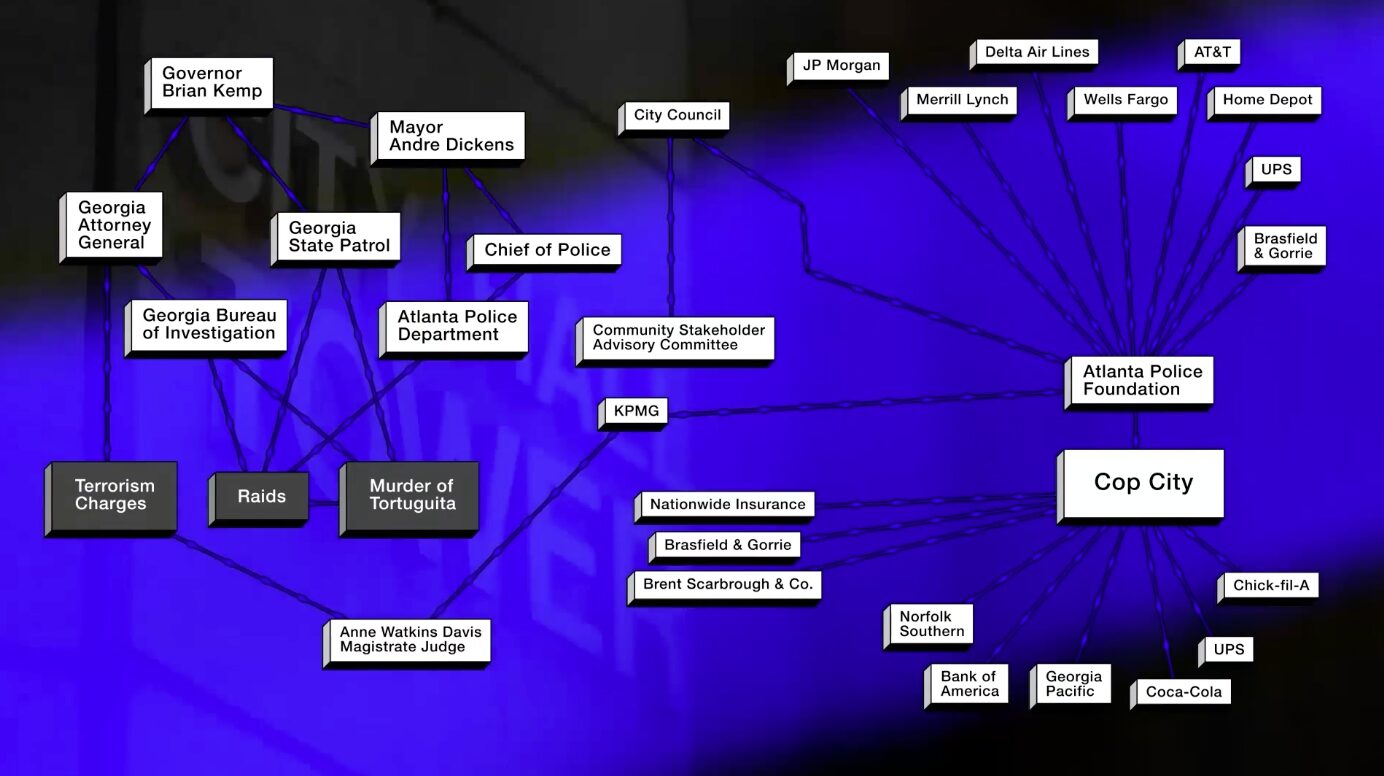
As Zohra Ahmed and I have written, the People’s RICO constitutes an account of the law and political economy of policing, of how private-public relationships endemic to neoliberalism siphon money to law enforcement in the ultimate service of capital gain. Police unions, here, participate in secondary and reactive capacities, while it is the Atlanta Police Foundation and city leadership who are the architects, funneling private dollars into policing infrastructure. Meanwhile, non-police labor unions were part of the organized opposition to Cop City, though after sustained movement repression the center was eventually built.
In putting forward an alternative account of criminality born from corporate and state greed, The People’s RICO’s reveals how much turns on whose theory of collective power becomes authoritative. As the KRS-One lyrics invoked by Paul Butler suggest, what counts as criminal is itself a political and legal construction. Here, too, Schrader’s history offers a revealing comparison. Schrader recounts how, in 1978, Newark police officers protesting layoffs smashed the windows of forty-six squad cars and sabotaged traffic signals. It is remarkable to consider this episode alongside contemporary prosecutions of protesters for vandalizing vehicles belonging to the police, such as the recent federal prosecutions in Minneapolis for damaging ICE vehicles during anti-ICE demonstrations, or the use of vehicle vandalism as a central to the domestic terrorism and RICO prosecutions of activists associated with the Stop Cop City movement in Atlanta in 2023. The power to organize collectively and the power to determine which forms of collective organization count as criminal are deeply related.
This account complements Schrader’s understanding of Blue Power as both operational and political, while revealing how that power is built and sustained through institutions, resources, and political-economic arrangements well beyond police departments and police unions. The Stop Cop City movement’s account of the relationships among corporate interests, private foundations, police, and city government helps us see how these arrangements produce and expand policing itself. And its competing account of conspiracy reveals another dimension of police power: the ability to make some forms of collective political action legally criminal while treating others as legitimate exercises of political power. The same expansive approach to knowledge that allows Schrader to reveal the political power of police officers can thus help us understand the broader political power of policing.
To return to AK-47, the band’s 1980 song challenged both everyday police violence and the official narrative of policing, while the police union’s response revealed the lengths to which organized police officers would go to defend their power. Shrader’s book shows us how organized police officers fought and continue to fight to maintain their power, including by contesting those who challenged them. With apologies to the vast literature on punk philosophy, we can think of a punk rock theory of policing as one that takes seriously the accounts and understandings of people who contest police power, as producers of knowledge about its sources, operations, and possibilities for transformation. The sources we use to understand policing shape the forms of police power we can see.