This post kicks off a symposium on Yochai Benkler’s recent article, Structure and Legitimation in Capitalism. Read the rest of the posts here.
** ** **
In the background of any claim about “law and political economy” exists some model, often implicit or unconscious, of what “political economy” is, what “law” is, and how the two concepts interact. If we do not develop this model, laying out explicitly our ideas and areas of agreement and disagreement regarding the structure and dynamics of political economy and of law, then we risk talking past one another, making internally inconsistent claims, or both. Unstated and unexamined, our models will almost certainly be some mixture of the Smithian waters we all swim in, interlaced with, often muddied by, islands of explicitly heterodox or vaguely Marxian economics.
In a recent article, Structure and Legitimation in Capitalism: Law, Power, and Justice in Market Society, I proposed a social theory of law in capitalism that seeks to avoid those limitations. It synthesizes several strains of heterodox and mainstream thought into a theory of capitalism and its dynamics and develops a conception of law in capitalism as a subset of the institutional political economy of capitalism so conceived. In this brief post, I outline the basic features of that theory.
Capitalism
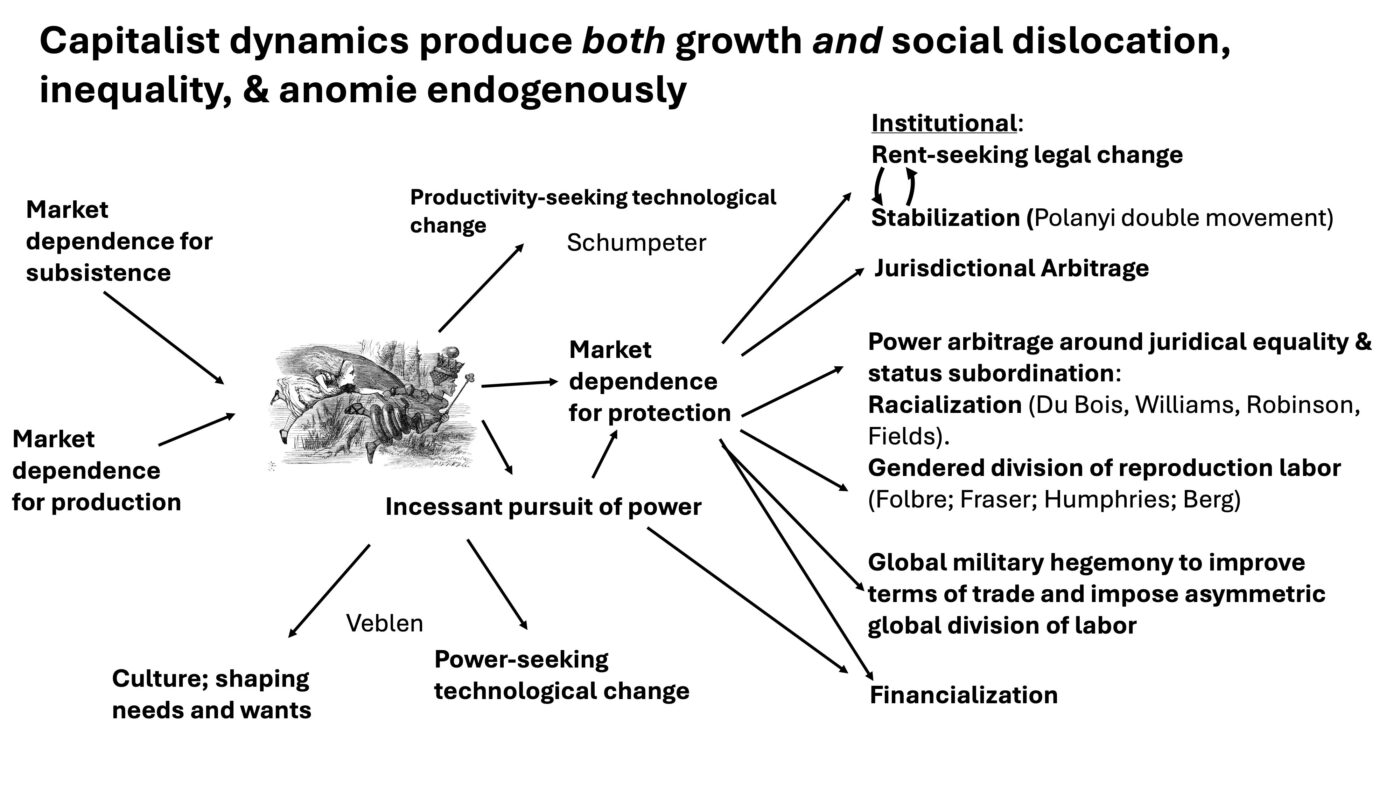
Capitalism is the form of social life that emerges when most people in a society live in households that depend on acquiring their basic needs through commodity exchange in markets, most organizers of production depend on commodity exchange to acquire the basic factors of production (labor, knowledge, resources, time), and the political military formations depend on selling debt into financial markets and taxing market income and transactions to sustain their fiscal needs. “Commodity exchange” means paying a price in a market transaction to someone whose relation to the buyer is defined as exchange among juridical equals bearing legal entitlements—property, contract—rather than through relations of kinship, religion, custom, or violence. The conjunction of market dependence for subsistence, production, and protection as the dominant form of each creates the incessant dynamics of capitalism, forcing us to instrumentalize our labor, knowledge, and the Earth. Market reach, how pervasive and all-encompassing commodity exchange is as the dominant social form, is what makes a society a modern market society, rather than a society with markets such as have existed since antiquity. It is a historically specific phenomenon that emerged at identifiable times, in specific societies, triggering dynamics that spread its imperatives across the globe and transformed human societies everywhere, whether they liked it or not.
Market dependence for subsistence forces all households to find a way to make money, providing the foundation for wage labor as a near-universal imperative. Market dependence for production forces all organizers of production—smallholders like family farmers, plumbers, or shopkeepers; professional and managerial services firms; or the largest corporate entities—to increase their productivity continuously to, at least, stay abreast of competitors, or to increase their power to become price makers rather than takers. It is this last imperative—the imperative to escape competition and create and renew quasi-rents—that drives both the spectacular dynamics of innovation and productivity growth historically unique to capitalism and its specific forms of power-seeking, exploitation, and social dislocation. Market dependence for protection forces the political military formations, for the first time in history, to prioritize the interests of those who control social relations of production—capitalists and rentiers—rather than exclusively the interests of political military and meaning-making (priestly) elites. It is why the oligarchic republic is the institutional gravitational well into which all capitalist societies are pulled.
The imperative to escape competition kicks off what I call the Red Queen Dynamic: all firms and smallholders depend on markets to obtain labor, knowledge, natural resources, and calls on these factors of production in the form of credit and finance, and must run as fast as they can just to stay in place. Markets are never perfect because competition endogenously drives everyone subject to these market imperatives to create, identify, and exploit non-competitive niches in time, space, and context. Power-seeking is the animating spirit of capitalism.
The Red Queen Dynamic drives both innovation—Schumpeter’s creative destruction—and social dislocation and exploitation—Veblen’s concept of “sabotage.” Capitalists are indifferent to whether their profits come from increasing productivity or power, growing the pie or grabbing a larger slice. Ideally, from the perspective of capitalists, they would develop the most productive innovation, creating quasi-rents for lead firms, and deploy it in the jurisdiction where they have the most power over labor, consumers, and suppliers to retain more of the rents that power creates for as long as possible. When it is cheaper and more certain to pursue gains from power, that is what capitalists as a population will do. The imperatives operate on the profit-reaping classes as a population, producing society-wide effects whether or not this or that firm is “nice” or “ethical.”
The pursuit of power proceeds along several dimensions well-explored in diverse critical literatures. These include power-shifting technological change, whether or not it improves productivity; manipulation of demand and desire; institutional transformation, including lobbying and litigation to change legal rules that shape power in social relations of production, as well as jurisdictional arbitrage; power arbitrage around juridical inequality and institutionalized status subordination, leveraging racialized and gendered class relations; global military force projection to impose asymmetric global division of labor and terms of trade; and an escape to financialized products, reflecting mostly redistribution and speculative returns rather than productive investment.
Law in Capitalism
Law is one of the primary systems capitalist societies use to structure social relations of production by institutionalizing market dependence for subsistence, production, and protection, and structuring the patterns and terms of coordinated collective action. It does so in interaction with other institutional sources (e.g., custom, religion, secular norms, industry practices), material context (nature and technology), and ideology. These also work to structure social relations of reproduction and their articulation with social relations of production to reinforce the asymmetries in both.
Law in capitalism is distinct from other institutional sources in two ways. First, it provides the fundamental frame within which modern market society conceives of social relations: exchanges among juridically free and equal individuals. Second, it is more amenable to direct intentional design than social norms or customs, and hence, offers the clearest institutional terrain to target for organized conflict over the structure and distribution of power in social relations. Whether and how victories in legal conflict stick as a structure of social relations, however, can never be a function of law alone. It depends on how legal design interacts with other dimensions of institutional and material context over time, and on how easy it is for the losing side to evade or innovate around it (technologically or institutionally).
Law structures social relations (1) functionally and (2) symbolically. Functionally, law serves (a) coercion and (b) coordination functions. First, it shapes social expectations about the use of legitimate violence—what actors can or cannot do to and with each other without triggering violence considered legitimate by other well-socialized actors in a society. Second, law codifies and communicates expectations about patterns of social relations that provide coordination points and frameworks for cooperation, making people’s actions mutually and reasonably predictable in the normal course of social life. Symbolically, law produces and communicates normative conceptions of how social relations ought to be. Because pronounced by a society’s legal formations as law, most well-socialized members of that society accept these normative conceptions as authoritative, enabling them to function as internalized regulation.
Law is social all the way down—both inside and outside the legal profession. Internally, law in capitalism is the product of a social formation that emerged in early modernity as a solution to conflicts that the rising capitalist class had in its relations with the political military formations, as well as with the working classes, smallholders, and status-subordinated underclass, as capitalists struggled to transform society in their own image. In that transformation, the legal profession carved out a role for itself that both contained the power of the political military formations and produced a conceptual and institutionalized apparatus to enforce the claims capitalists had against each other and the other classes. Through education, practice, and habituation, the profession became a self-reproducing social formation that generated an internally shared sense of what a “legal” resolution to a conflict is. Externally, through violent coercion of the working and, initially, smallholder classes, and through sustained efforts by the meaning-making formations of capitalist societies, the legal profession became the social formation whose pronouncements are internalized by most well-socialized members of society as authoritative regarding what the law is and should be. Part of the professional and managerial class, but set apart, bridging the profit-reaping classes and political military formations, the legal profession became a central pillar of the institutional structure of capitalism. There is nothing to law’s power to structure and legitimate relations in capitalism other than this historically specific social dynamic.
Law in capitalism structures social relations of production by defining entitlement-disentitlement pairs with respect to the core elements of production: labor, knowledge, resources, and time and uncertainty. For instance, as I detail in the article, law structured access to the means of subsistence—in the Parliamentary Enclosures by extinguishing land use privileges the rural population held to produce food, fiber, fuel, and building materials; in the postbellum South by closing the open range, expanding trespass law, and prohibiting hunting and fishing so as to force formerly-enslaved Black families into debt peonage; and in twentieth-century conflicts over welfare capitalism. The Homestead Act of 1862 and the New Deal are examples of cross-class coalitions that succeeded in passing laws to alleviate the imperatives of market dependence for subsistence. In all these, law was a terrain of struggle over what alternatives most people had to accepting waged labor under exploitative conditions, and hence the degree of asymmetric power capitalists held. I also survey briefly the range of laws structuring control over production, from the more obvious labor and employment law through law governing knowledge in production, not only technology but also training and embodied knowledge, as well as access to credit. These, in turn, shaped the distribution of power among the profit-reaping classes, smallholders, and workers.
By understanding capital as a social relation—institutionalized roles in production with respect to labor, knowledge, resources, and time—we can break down analytically what the roles are in relation to each other with respect to what components of production. This allows us to locate different aspects of law in terms of their role in producing the imperatives of capitalism and the relative power of those who systematically fill different roles—that is, class power—and to target transformative reform proposals to what can actually shift the structure of the relation.
As to the internal practice of law and legitimation, I lay out modes of reasoning that have been accepted by common lawyers as appropriate moves within legal argument. This habituated acceptability is the basis of legitimacy within the profession, which, in turn, is the foundation of external legitimacy—acceptance in the broader population through the mediation of acceptance by the profit-reaping classes and political military and meaning-making elites.
Contrary to conservative nostalgia and critical periodization of classical legal thought, pragmatism, and neo-formalism, I find that eight modes of reasoning occupying well-defined conceptual roles vis-à-vis each other have been present in judicial opinions at least since the 18th century. We find law and economics-style formalist realism alongside formalism, idealism, historicism, and pragmatist realism in 18th-century opinions, law and sociology realism cheek-by-jowl with Lochnerian formalism in the 19th century, and the whole panoply in contemporary opinions. The point is not that law is radically indeterminate in practice. If indeed any outcome were possible in any conflict, depending on the luck of the judicial draw, law could neither structure nor legitimate social relations. It would be epiphenomenal. But legal predictability comes not from law having internal, necessary results for given cases, but from the habituated professional judgment and the weakly informed beliefs of the broader population about what is the likely outcome at a given period, given the known patterns of decisions of the then-sitting judiciary. Determinacy in law, like the structuring and legitimating force of law in capitalism, is social and historical, not conceptual. In 1990, resting one’s statutory interpretation case on a pile of dictionaries ignoring legislative history and purpose would have been malpractice. What has changed since then was machtpolitik, not intellectual enlightenment. Yet “we are all textualists now.”
What are the implications of this social theory of law in capitalism for transformative reform? First, because market dependence for subsistence is foundational to capitalism, meaningful decommodification of access to basic needs and goods—Freedom from Want—is a precondition to transformative reform. Second, because capitalism continuously recreates and intensifies relations of racialized, gendered, and other forms of atavistic status subordination as part of its class structure, no social democratic transformation can occur without sustained elimination of the most pervasive modes of status subordination—racialization, gendering, and immigration status. Third, because law structures power in social relations of production, transformation requires partial socialization of labor, knowledge, credit, and infrastructure markets to enable democratic governance over the path capitalism takes.
Properly harnessed and constrained, capitalist dynamics can produce incredible productivity growth and material well-being. Left to its own devices, capital persistently drives toward a mixture of upward redistribution, financialization, and endogenous instability. The combination of partial decommodification of access to basic needs and partial socialization of the elements of production is the only path to transforming capitalist societies. And only such a social democratic transformation can prevent the collapse of the present American liberal oligarchic republic into ethnonationalist competitive authoritarianism.