Could there be a starker contrast between the two best-known American leaders in the world today? One pursues wars of choice; the other prays for peace. One posts dyspeptic diatribes daily; the other pens graceful reflections on matters of ultimate concern. One wants to accelerate AI to the limit, preempting state regulation and bullying Europe into techno-laissez-faire. The other has published Magnifica Humanitas as a blueprint for promoting AI’s best applications, while reducing its harms.
These contrasts are inspired by the rhetorical structure of Magnifica Humanitas. Throughout the encyclical, the Pope deploys dichotomies to clarify its aims. For example, he commends a “civilization of love” and condemns a “culture of power.” In this spirit, I want to propose an interpretation of Magnifica Humanitas that contrasts it with the current U.S. government’s approach to AI. I will organize my interpretation around two symbols adopted by the Vatican and the White House, respectively. Magnifica Humanitas pictures and promotes a dove of peace, a staple symbol in Christian scripture and art. Trump 2.0 AI policy, by contrast, appears to be going in the direction of the “nihilist penguin,” a trope of the terminally online.
In the story of Noah, a dove brings an olive leaf after the flood to mark the end of this divine punishment. All four gospels describe the Holy Spirit descending upon Jesus “like a dove.” The dove is associated with the Holy Spirit in Catholic art, taking part in its trinitarian theology. Christians have seen the dove as a symbol of peace and reconciliation, and secular peace movements have also adopted it. It brings to mind purity and innocence, unstained by violence or avarice. Pleas for peace are woven throughout Magnifica Humanitas, and a dove appears in one of its illustrations.
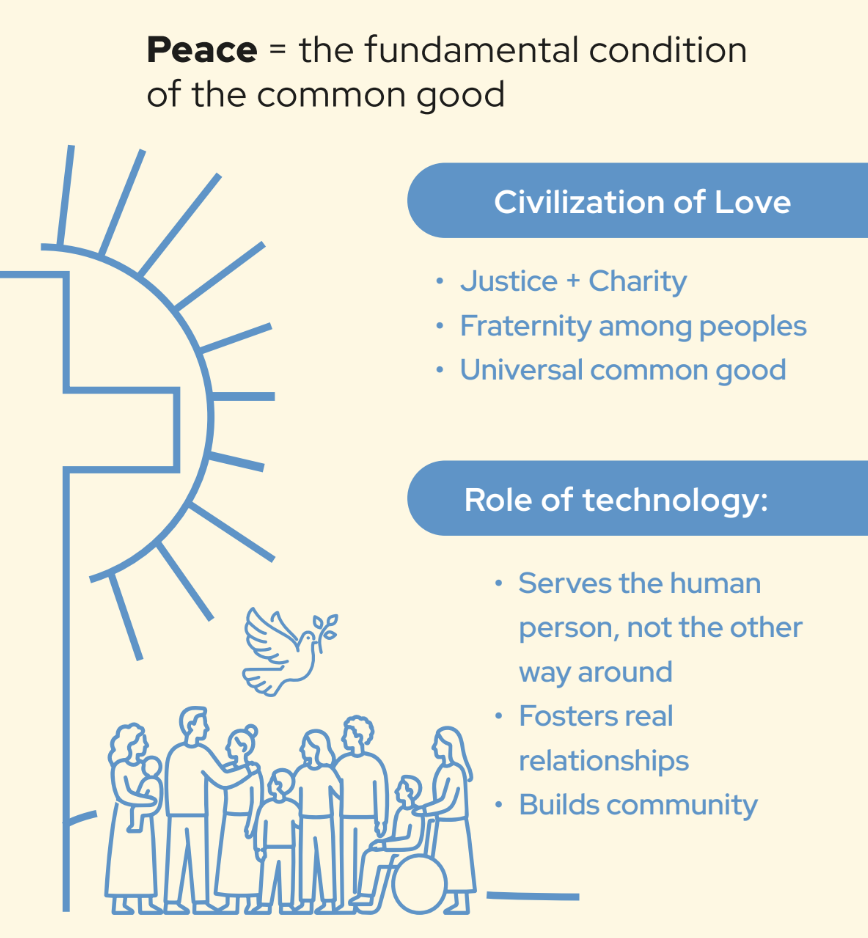
While the dove of peace has a long history in iconography, the “nihilist penguin” is a MAGA-appropriated meme of recent vintage. In Encounters at the End of the World, Werner Herzog described a penguin that deserted its flock’s natural coastal range and instead headed inland, toward “certain death.” Internet users meme-ified the mysterious deserter as a YOLO (“you only live once”) icon. More recently, it has been seized upon by the White House, DHS, RFK Jr., and others to troll liberals—for example, to cheerlead the bizarre demand for Greenland (in an AI-generated image below, posted by the White House).

The nihilist penguin is typical cannon fodder for the regime’s slopaganda machine.
In the dove and the penguin, the moral seriousness of the Pope and the frivolity and cynicism of the President are vividly disclosed. The question now is whether a message of moral clarity can break through the militarism and media manipulation of the present age.
The Dove of Peace
The word “peace” occurs 88 times in the encyclical, and perhaps only “justice” appears more often (97 times) as a normative aim. One of the longest sections in Magnifica Humanitas covers the military uses of AI, beginning with a critique of the “normalization of war” (189). Far from welcoming an age of precision warfare, Pope Leo demands that the “the development and use of AI in warfare must be subject to the most rigorous ethical constraints” (197). He flatly states that “it is not permissible to entrust lethal or otherwise irreversible decisions to artificial systems” (198); “those who design, train, authorize and employ technology must be held accountable for their decisions” (199). The advance of both computation and market forces has already led to a black box society, where so many critical decisions about our lives can neither be understood nor challenged. Magnifica Humanitas prescribes a strict boundary between such opaque technology and the prosecution of wars.
The encyclical complements these policy recommendations with searching reflections on the interiority that supports war. As the Pope observed in a recent speech to the Spanish Parliament, “The expanse of one’s vision consists precisely in looking more deeply at what is at stake in every public decision. This is why, alongside technical solutions and legal reforms, a moral renewal is also needed.” Magnifica Humanitas rightly laments that “Public opinion is gradually being shaped and conditioned by polarizing media narratives, which are often amplified by algorithms that prioritize conflict and confrontation” (190). Dialogue and mutual understanding are impossible in such an environment. Left unchecked, algorithmic media result in the gradual degradation of communicative into strategic action. This is made all the easier by the behaviorist YouTube apparatus and post-social media:
Communication networks, fragmented information environments and algorithms that reward conflict can magnify polarization and resentment, increase propaganda and make shared discernment more difficult. Thus, war is not only fought, but also culturally conditioned through simplistic narratives, a friend-or-foe mentality, disinformation and fear. When historical memory fades and the ethical principles that protect civilians and the most vulnerable are weakened, it becomes easier to justify violence. (192)
Magnifica Humanitas calls for a better media culture, noting that “those who control digital platforms and means of communication have a considerable ability to affect the collective imagination,” and “such power should be constantly guided by the pursuit of truth and respect for human dignity” (136). It is hard to imagine a better rationale for the EU Digital Services Act and AI Act, as well as careful fact-checking. Of course, these are all initiatives that the US government is now undermining by designating them as “censorship.”
The Nihilist Penguin
US AI policy today is both blunt in its aspirations and self-contradictory in its methods. The Administration’s AI Action Plan states that “America is in a race to achieve global dominance in artificial intelligence,” promoting the very “culture of power” that Magnifica Humanitas laments. Whatever one thinks of this goal, it is clear that an abundance strategy for energy, as well as wise industrial policy, is critical to it. Neither is now being pursued.
Current US energy policy is confoundingly counterproductive, reflecting bare animus against renewables. Like a latter-day Don Quixote tilting at windmills, the President has attacked wind power and blithely lied or BS’d about its prevalence in China. His Secretary of Energy recently humiliated himself before Congress by exhibiting blatant ignorance about (or struthious refusal to recognize) basic battery technology. You can’t seriously claim to aspire to “global dominance” in AI, when the technology requires massive increases in energy use, your main rival is increasing its power capacity massively, and you’re trying to shut down or hamstring renewables.
AI industrial policy is little better. The technology economics well-described by Daron Acemoglu, Kyle Chan, TP Huang, Mariana Mazzucato, Jordan Schneider, Jeff Ding, and Dan Wang, among others, is largely absent. The White House answers to policy question about AI tend toward blunt deregulation and boosterism, while AI’s productive advance needs both careful subsidy and rule-making to promote benefits while reducing risks. Renewed investment in education and university research are critical to AI development and diffusion. Of course, now both are under attack. Just when we most need government to act with a scalpel, carefully applying expertise to new technology, it has been reduced to a chainsaw, sledgehammer, or woodchipper.
The common thread of all these approaches is a deep willfulness, a “you can just do things” attitude elevating agency over strategy. It’s Fyre Festival logic: “Let’s just do it and be legends, man.” Or, “move fast and break things.” There’s no comprehensive ideology to discern here, even though the “woodchippering” of USAID may well lead to more deaths (up to 14 million by 2030) than the Soviet famines of 1930-33 (5.7 to 8.7 million, by some estimates). One day AI is the national-security-critical tech in need of the strictest control; the next it’s an ordinary commercial item that barely merits regulation. There are just a series of lurches toward or away from sets of Administration allies, depending on whatever happens to be the mood or perceived self-interest of the President or top officials on a given day.
Enter the penguin. It embodies irascible willfulness, even to the point of self-destruction. It’s one more symptom of the internet’s nihilism crisis, one more step toward the “nothing matters” insouciance of online edgelords. Journalist and internet theorist Max Read was rightly incredulous at the Administration’s embrace of the meme. As he relates:
On TikTok, the penguin was imbued with [some] quasi-ironic inspirational qualities…And one can imagine a relatively innocuous U.S. government adaptation: Americans love the idea of crazy dreamers, hardy individualists, and maverick visionaries…But in general they like those stories to end with success and accomplishment, not death by exposure.
Read compares the meme to the work of Yukio Mishima (who glamorized willful self-sacrifice in service of hopeless causes in several novels, such as Runaway Horses), and the infamous “Flight 93 election” essay. This triumph of the will over memory, intellect, or strategy is a kind of political intoxication. Even in well-established areas of policy, it can cause great disruption and suffering. In an area as new and contested as AI governance, it can come to no good end.
But it’s fun to watch and quote and dispute, so perhaps it’s a win in a morally bankrupt attention economy. Like the dirigibles in Mark Doten’s novel Trump Sky Alpha, political discourse appears to float free of its material consequences. We all know that whatever failures or disasters that result from the chaos described above will be blamed on the enemies of the administration. It’s hard to tell whether the current media landscape (and gerrymandered political system) will let alternative narratives reach a critical mass of voters.
The Penguin or the Dove?
It may seem faddish, whimsical, or just plain random to organize an essay on Vatican and MAGA AI policy based on two birds each side has used in their media. But interpretive social science teaches us (among other things) to try to see the world in a grain of sand. What should be clear by now is that each side’s symbol resonates with profoundly different habitus, lifeworlds, and moral horizons. It is these outlooks I’ve sought to illuminate here—the culture upstream of the politics they pursue.
In a recent essay in e-flux, Dominic Pettman observed that the “edgelord intellectuals who have managed to help shape the fantasies and ambitions of the current powerbrokers are joyously complicit in the enshittification of the world.” Enshittification was the MacQuarie Dictionary’s word of the year in 2024, designating a general sense of decay and decline, particularly at the very internet platforms now leading the charge into AI. The term has both staying power and precise theoretical formulation in the capable hands of its coiner, Cory Doctorow. Initial investment, enclosure, and extraction are three key steps. Once a communications platform has a monopoly, or just significant inertia, it can serve its users gradually increasing amounts of slop and advertising. And the owner’s ideology can easily seep into the algorithms governing the reach of the speech of its users.
In an even minimally functional marketplace of ideas, the ideals of Magnifica Humanitas should influence far more people than the cacophonous caravan of memes and slogans now standing in for US economic and social policy. But I do not know if such a marketplace still exists. Look at the images above, or the contrast below (again between a Vatican illustration and White House media), and consider what might be more likely to go viral, to stoke engagement, and to etch itself in memory.
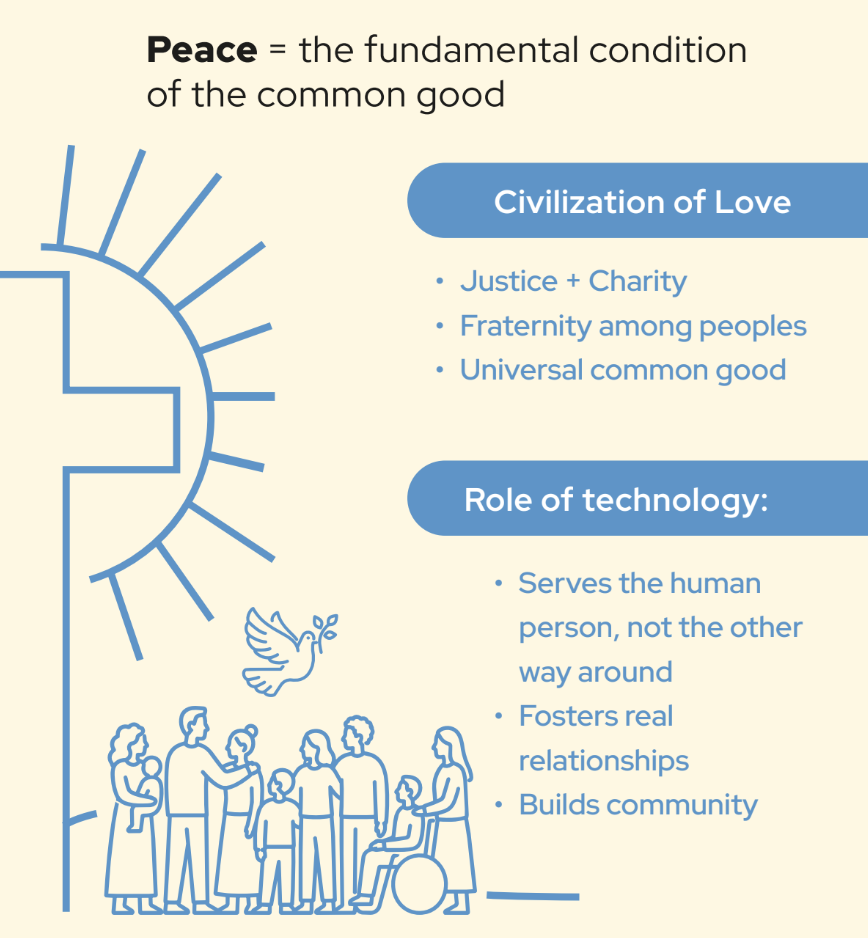
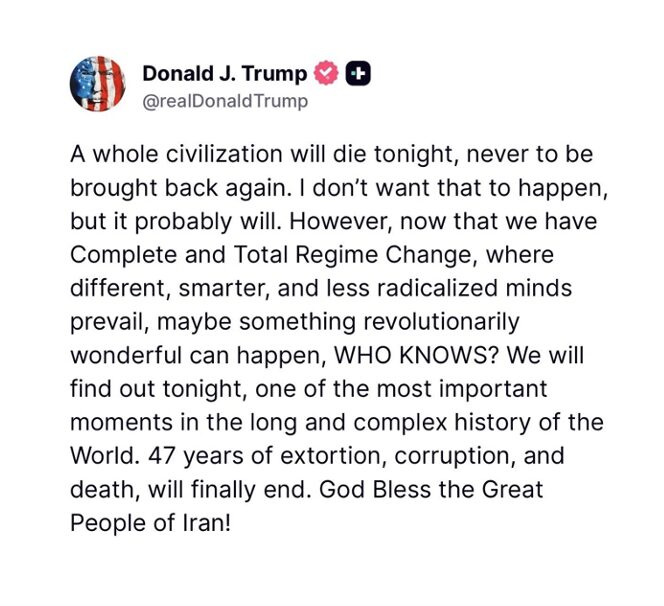
The heedless willfulness of the nihilist penguin much better suits the emerging spirit of large Internet media platforms. It is darkly anarchic, choosing chaos over community. But its path offers only an illusion of autonomy, whether at the personal or national level. We must hope that the ideas about media, communications, and orientations of the heart at the core of Magnifica Humanitas will resonate with wider circles of people of good will. “Let us invest in education, beginning with ourselves!” the Pope proclaims. “Teaching new generations that technological evolution does not follow a predetermined path, but can be guided by personal and collective responsibility, constitutes one of the most valuable services to the common good” (238). Much work on this blog, and the larger law and political economy of technology community, has done that teaching well. So let us continue, knowing that even in dark times, hope is at hand.