This post concludes a symposium on Yochai Benkler’s recent article, Structure and Legitimation in Capitalism. Read the rest of the posts here.
** ** **
No human being is born a fully formed individual, a free agent characterized by attributes naturally applicable to all human beings. All of us are born already in relation to each other, each formed by the relations and roles we occupy vis-à-vis others as parents and children, siblings, and later wider habituated social relations. These roles and relations are defined and structured by the inherited institutions we inhabit together.
By “institutions,” I mean the patterns of behavior into which individuals must fit under penalty of coordinated social resistance, and the social mechanisms of their production or enforcement. We are born into habituated practices enforced on us by those whose social role is to raise us, and we internalize these as our way of being. As the scale of a society increases, the diversity and complexity of roles and relations expand, and it develops more formalized social mechanisms to define and enforce its institutions. Law is the mechanism for producing explicit instructions for such patterns of behavior that are susceptible to enforcement by legitimate violence.
Every human society is characterized by four domains of social relations: reproduction, production, protection, and meaning-making. To continue to exist, any society must reproduce, biologically and socially, and feed, shelter, clothe, and harness energy for its members. Social relations of reproduction and production are primary; the asymmetric positions in these relations are what we call “gender” and “class,” respectively. Social relations of protection are those that structure violence within societies and between them; the asymmetric positions in these we call political and legal “authority.” Finally, all human societies have narratives for making sense of the world, defining who “we” are and understanding the natural order and how we fit into it. These are produced through social relations of meaning-making, the asymmetric positions in which we call “status,” “membership,” and “epistemic authority.” In capitalism, social relations of production exert outsized force on all other domains, distorting and warping relations of reproduction, protection, and meaning-making without fully annihilating their internal institutional capacity to structure relations in their distinct domains.
In this way of understanding social life, social relations are the basic unit of analysis. This approach, as I explain in what follows, shapes my response to the probing questions raised by Katharina Pistor, Jed Purdy, and Matthew Dimick—to whom I am grateful for taking the time to read and respond so thoughtfully to my article. It clarifies how I understand the place of “the state” in capitalism; the relationship between culture, technology, and politics; my theory of law and legitimation; and my conception of profit.
The State in Capitalism
Social relations of protection determine who may issue orders susceptible to enforcement by legitimate violence; who must obey whose orders; who may impose violence considered legitimate, subject to what conditions; and who has the power to shape the answers to these questions. In larger human societies, social relations of protection experienced as legitimate by most well-socialized members of society make up the polity.
“The state” is an abstraction for those specific social formations that fill several roles in the social relations of protection. I use the term “political military formations” rather than “the state” to characterize the dynamics within and between these formations. These include formations that actively enact coercive force (the “military” and “police”); political formations that bear both internal legitimacy vis-à-vis the military formations (their orders will be followed) and external legitimacy toward the population as a whole (the divine right of kings, or the will of the people democratically assembled); and administrative and judicial formations, both of which are dedicated to the administration and legitimation of the decisions of the formations holding authority (the former relying on expertise and bureaucratic process for legitimation; the latter, on law and legality). Both the administrative and judicial formations are part of the professional managerial class and, in capitalism, provide a bridge to the profit-reaping classes, capitalists and rentiers.
In pre-capitalist and non-capitalist societies, the political military and meaning-making elites determined the use of coercive power (Chief/Shaman, Crown/Church, Party/Generals). Elites of social relations of production, such as merchants and moneylenders, were excluded through ideologies of “filthy lucre” and designation as outsiders. As the invention of new weapons and development of a professionalized military raised the cost of warfare in early modernity, larger scale polities extinguished smaller feudal formations. Unlike in Charles Tilly’s “war made the state and the state made war” account, where the modern state is defined by expanding administrative capacity to expand fiscal capacity to meet those rising costs, in mine early modern European polities bifurcated into (a) absolutist states and expanding empires whose fisc depended on controlling territory and levying tributes, land taxes, tolls, and mineral leases; and (b) capitalist states that depended on selling tradeable debt into financial markets and taxing market transactions. The latter’s fiscal model allowed them to harness their fiscal (and hence military) capacity to the dynamic growth of capitalism, enabling them to punch far above their geographic and demographic weight—a phenomenon that occurred first with Venice and Genoa, later with the Dutch Republic and England, and soon thereafter in the United States.
The upshot is that in early capitalist states elites of social relations of production—capitalists and rentiers—came to play a large role in deciding how to deploy coercive violence. This did not make “the state” in capitalism the handmaiden of capital. The political military formations have internal social dynamics related to their roles in keeping the peace domestically and projecting force geopolitically. Most importantly, they seek to maintain internal quiescence, social stability, and compliance to reproduce their role in society, while capital endogenously drives dislocation and upheaval because of the Red Queen Dynamic. That is the driving force behind Polanyi’s double movement: spirals of institutional changes through which first, the political military formations provide capitalists and rentiers with what they need to boost profits and increase fiscal capacity, followed by, second, efforts to re-stabilize society from the dislocation that the continuous pursuit of profit causes. Factions within the political military formations and sectors among the capitalists seek to recruit various of the other formations to their program. This includes the recruitment of other classes (such as capitalists and the GOP recruiting white working class voters) and the recruitment of meaning-making formations (such as neoclassical economics or the conservative legal movement). These struggles result in periods of repose, in which a given regime settles into a self-reinforcing structure, followed by periods of disruption, driven mostly by internal dynamics of capitalism globally and its incessant pursuit of power for profit (including capital from other capitalist societies), and episodically by external shocks from non-capitalist societies.
Jed Purdy asks if, in this theoretical model, the economic order precedes and shapes politics (in his diagram, “ECONOMY -> politics -> law -> economy”). I see, rather, parallel and recursive feedbacks. Institutions are primary. They shape what the material conditions mean. For example, coal and oil deposits shaped Britain and the United States a century or more before they shaped Germany or Saudi Arabia. These fossil fuels were, of course, always there, but they only became “capital” to be extracted and instrumentalized under certain institutional conditions. Institutions and habituated practice shape consciousness, hence institutions precede ideology through habituation. The pattern is recursive and shapes each society’s relations between the political military formations and those of class, and between one society and all other societies given its implications for their respective production and protection capabilities.
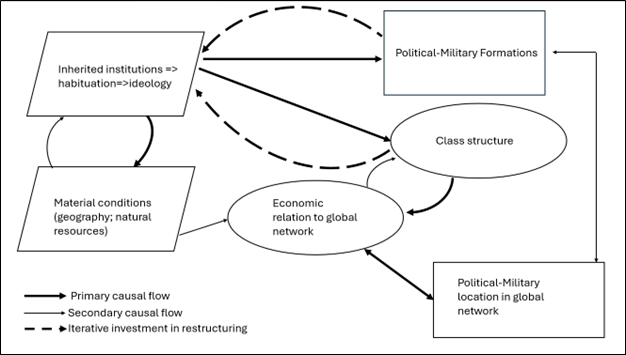
In my Global Origins of Capitalism, I synthesize this causal flow with the reconstructed class analysis that Talha Syed and I put forward to describe the major lines of class struggle and conflict, potential class coalitions, and how these interact with the political military formations. The next figure illustrates this dynamic.
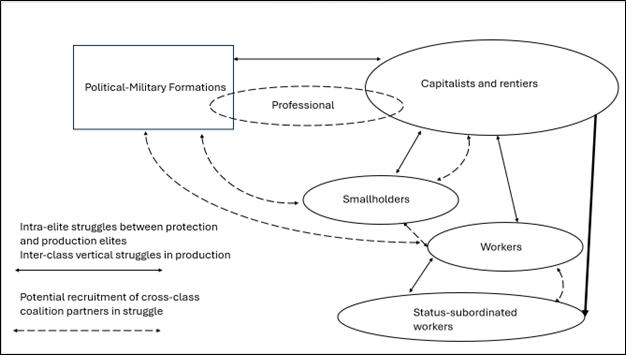
In this model, “politics” are not superstructure to “the economy’s” base. Yet market dependence for protection—the fact that a society’s political military formations depend on their ability to sell government debt into financial markets and tax market transactions—exerts an oligarchic gravitational pull on capitalist states. Selling debt into financial markets requires assuring creditors that the political military formations will prioritize their interest over competing considerations. Defense of wealth—oligarchy—was historically more important than rule of law in selling public bonds. Democracy is a constraint on prioritizing the interests of wealth holders over those of everyone else. Hence, Venice and Genoa were oligarchic republics.
The mass inflow of diverse refugees that kicked off the Dutch Golden Age required a new conceptualization of the “we.” Life in a society defined by commodity production and exchange as the dominant form of subsistence and production provided the answer. What emerged was liberalism—reimagining the polity in the image of capitalist social relations—a contract among juridical equals built on their natural individual right to life and to property in the means of life. Grotius first articulated this framework, followed half a century later by Hobbes.
The governing model of capitalist states became the liberal oligarchic republic: justified in terms of individual rights, oligarchic in function, and representative in governing structure. England, the Dutch Republic, and soon thereafter the United States became liberal oligarchic republics. When absolutist monarchies adopted capitalism two centuries later, they adapted the model to their own inherited institutions. Bismarck’s Germany and Meiji Japan implemented authoritarian corporatism, and both, through cartels and zaibatsu, empowered the capitalists. Korea and Taiwan followed similar trajectories. China, particularly since the clampdown on capitalist superstars, has been trying to build a novel form of capitalism where the political military formations retain dominance over the capitalists while preserving the dynamism. There are good reasons to think the model will fail—that China will either converge to authoritarian oligarchy or that growth will falter. If it does succeed in maintaining its present path, it will have birthed a new variant.
That oligarchy exerts a persistent gravitational pull on capitalism is not cause for despair. It can be, and has been, overcome through mobilized social and political struggle. But stable democracy requires social democracy, a degree of real freedom from markets, not liberal democracy that collapses toward the oligarchic gravitational well. As Thaddeus Stevens insisted in the aftermath of the Civil War, confiscating land from Southern planters and redistributing it as land grants and startup cash to formerly enslaved households was a precondition to democratic transformation in a Reconstructed South, while voting rights and juridical equality alone could not do the job. In our times, the greatest successes of the liberal rights revolution in America, the Civil Rights and Women’s Movements, co-existed, indeed co-evolved with, and were recoded to legitimate, neoliberalism, as Nancy Fraser argued in Capitalism, Feminism, and the Cunning of History.
Culture, Profit, and Legitimation
Culture. Turning next to the question of culture in this theory. In capitalism, the compulsion of competition drives continuous instrumentalization of meaning-making for profit. Fashion has been a major dimension of demand manipulation, leveraging status-anxiety and collective sense-making for profit in a constantly changing society since the 17th century.
As with law, social relations of meaning-making are instantiated in social formations that emerge in history and reproduce through internal institutions. Religion is most obvious. The emergence of televangelists in the 1970s-1980s is an example of the profit imperative transforming religion as meaning-making. So too with perennial conflicts over corporate money in academia or journalism. In Network Propaganda I lay out how changes in radio and television receiver regulation and satellite communication interacted with the 1970s transformation of American politics and backlash against the Civil Rights and Women’s Movements to create the conditions for the Christian Broadcasting Network’s and Rush Limbaugh’s profitability in the 1980s; in a Boston Review article, I explain how these changes were necessary for the rebellion of capital and its need to forge a cross-class electoral coalition between the capitalist and rentiers and the disaffected white working class. As with the state, media is not superstructure. It is a terrain of struggle impelled by profit seeking and played out against inherited institutional structures that provide real resistance to full instrumentalization, shaping the patterns of social relations of meaning-making differently in different societies (e.g. BBC/CBC vs. ABC-CBS-NBC => CNN/Fox/MSNBC).
Profit. Matthew Dimick suggests that my usage “rent” and “quasi-rent” implies that I assume a background competitive market from which power deviates. While I do use “rents” for ease of exposition, I do not assume the existence of a competitive baseline. Capital is a social relation, neither a thing nor many things, neither homogenous nor heterogenous. Profit is the share that capitalists and rentiers capture from that relation above the costs they are forced to pay in that relation to others who, like them, are trying to seize a larger share of the fruits of production. Neither “price” nor “profit” are naturally occurring quanta bearing a definite relation to some underlying “value.” What people want and how much they will pay for it is the object of manipulation and struggle. Wages above barest subsistence are a function of institutionally structured desperation and power. Investment and credit follow anticipated profits, hence anticipated power in future commodity exchanges. The animating spirit of capitalism is the pursuit of power—organizing production so as to sell commodities at the highest possible price, paying the lowest price possible for labor and inputs. Prices—in product, labor, and factor markets—are always and everywhere a function of institutions and struggle within them.
Legitimation and law. My account of law and legitimation in capitalism centers on the historically-specific role of a specific social formation—the legal profession—that, through education, practice, and habituation, generates an internally shared sense of what counts as a “legal” resolution to a conflict. In his response, Matthew Dimick objects that the connection between this theory of the law and capitalism is underspecified: “we only know that lawyers and judges share some legal-professional habitus, but we do not yet know what, precisely, is shared. Is it a habitus resonant with the Lochner era, the New Deal settlement, the civil-rights revolution, or the contemporary conservative counterrevolution? … Benkler’s account thus remains surprisingly formalist. More seriously, it is unclear why any particular legal-professional habitus should be capitalist legitimating. As far as I can tell, the relationship between any possible habitus and capitalism is completely contingent.”
My position is not formalist, but social, and law’s relation to capitalism is not contingent, but historically-specific. The legal profession is part of the PMC in capitalism, functioning within and mediating between social relations of production and protection. Its internal practices develop and adapt as capitalism reshapes market societies over time. Law took its form within capitalism at historically specific times when specific societies transitioned to capitalism. The Coke-Selden-Hale invention of the historically venerable and continuously improving common law emerged as part of England’s capitalist revolution, 1621-1688—displacing religious and absolutist alternatives with a formation that was closely integrated into the profit-reaping classes. The legal-professional habitus adapts to resonate with the regime of capitalism in its era. Lord Kenyon revived common law criminal prohibitions on grain middleman functions in the Waddington case (1800), though Parliament had abolished the statutory prohibitions in 1772. When Kenyon died two years later, common law prosecutions of grain arbitrage died with him as the government appointed the Smithian Lord Ellenborough, Waddington’s advocate, in his stead. This is not a one-off, but an illustration of the basic dynamic, particularly in common law jurisdictions where judges are experienced practitioners, and practice is overwhelmingly in the service of capital. This same kind of phenomenon was observed by Morton Horwitz, who demonstrated how judges adapted the most basic theories of property law in the 1820s and 1830s to support emerging industrial capitalists in their conflicts with existing agricultural users over water-powered mills, and can also be seen in the present role of the judiciary in the revolt of capital against the “Golden Age” institutions. I may be wrong on the history; I may be (mistakenly) called a vulgar materialist; but I don’t see either what’s mysterious about this straightforward dynamic or how it is either formalist or contingent.
Dimick’s alternative proposal, “that we think of adjudication as a practical activity” and “that what judges must do constrains what they can coherently say” leads him to invert the causal direction between legal form and capitalism. He writes: “the legal form will typically produce determinate, capitalism-friendly decisions because the bilateral, practical-normative grammar of rights and individual responsibility gives juridical expression to a commodity-producing society.”
On my view, the causal direction is reversed: the bilateral grammar of rights and individual responsibility gives legal form to the emergence of capital as a social relation in historical time, and that “grammar” arises from the fact of living in a society gripped by commodity production and exchange as its dominant mode. Individual exchange between strangers arises as the foundation of liberal political theory and liberal legality to explain, theorize, and eventually stabilize and legitimate a novel form of social relations that emerged before law made that change, out of institutional and material changes not pre-designed to produce the novel social relations of capital. It is the habituation into capital as a social relation, the doing of life in capitalism, that produces the consciousness and form of liberal legality, not the other way around.