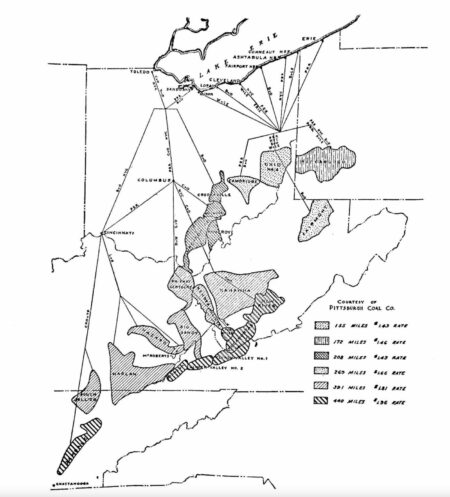
In the two decades before the Hepburn Act’s enactment, two entities vied for the right to coordinate the price and distribution of coal. The first—a group known as the Joint Conference of Miners and Operators of the Central Competitive Field—was the child of the United Mine Workers.The second—a group of coal-hauling railroads known as the Seaboard Coal Association—was the child of J. P. Morgan and the Pennsylvania Railroad. Understanding their struggle for power (and why capitalists rather than workers won), can help us better understand the stakes of antitrust.
In my new article, Monopolizing Whiteness, I examine the causes and consequences of “white island districts,” i.e. those that enroll predominantly white and affluent student bodies, despite being in racially and economically diverse metropolitan areas. I theorize that white student segregation in districts like GPSD is a product of (what sociologists refer to as) social closure— a process of subordination whereby an in-group works to curtail an out-group from accessing resources constructed as scarce. I suggest that the “essential facilities” framework of antitrust law can help to illustrate what a legal framework looks like that could appropriately recognize and address the process and harms of social closure.
Understanding the law’s role in the project of Israeli colonization requires examining how distinct legal frameworks applied across a legally fragmented space can nevertheless share a common defining logic. One manifestation of this shared logic becomes evident by scrutinizing claims to land adjudicated by Israeli courts: Israeli state agencies and Jewish settler groups are treated as presumptively proper claimants of property while non-Jewish Palestinians are treated, at best, as dwellers who are not entitled to claim property but merely inhabit the land at the sufferance of Israeli authorities.
Antoine Vauchez is a CNRS Research Professor at Université Paris 1–Sorbonne and a Permanent Visiting Professor at the iCourts research center at the University of Copenhagen.
Increasingly progressives are championing “public options” as a response to various market failures. Public options in the all-important health care space stand in for old-school regulation of private providers and old-school redistribution (to better support those struggling to pay for private insurance and medical services). Public options in banking, likewise championed by leading progressives, work substantially…
More so than blind faith in the market, U.S. family policy embraces the principle that government should not intrude into parents’ choices on whether and how to raise children.
Are social media platforms more like common carriers or newspapers? The answer is neither. And that answer has significant implications for how Courts should treat regulation of content moderation.
As markets began to usurp other forms of social regulation throughout the 20th century, metrics became increasingly central to the coordination of new spheres of market-mediated relations. More recently, digital metrics have been operationalized to facilitate the platformization of those domains. Platforms use automated scoring systems to rank content and actors across the markets they mediate. Search engines, e-commerce sites, and social media feeds all have ways to rank material and deliver it to users according to their calculation of “relevance.” This post explores metrics and gatekeeper power through the Google Scholar platform and its intermediation of the “scholarly economy”—the domain in which research is produced, consumed, bought and sold.
Would reconsidering the state/private action divide in First Amendment jurisprudence just unleash a torrent of endlessly abusive communications and misinformation of all kinds? Can antitrust categories help to solve the problem?
The touchstone of contemporary disability law, the Americans with Disabilities Act of 1990, was a victory of the militant disability rights movement, and was drafted with the social model in mind. However, Congress essentially delegated the design for this mandate to the Reagan-era EEOC, which in turn operationalized accommodations through private exchanges between employees and employers. Market logic further limited its redistributive work and society’s ability to critique its effectiveness.
Whether or not an information fiduciary model would be the best way to regulate data governance, it is not guilty of many of the accusations that Lina Khan and David Pozen lob at it.
The inequities and exclusions of the U.S. health care system are well known, but the two prevailing strategies in health law and policy—privatization and technocracy—both fail to address disparities in power that produce health injustices. To advance health justice, we need multiple pathways through which everyday people—acting both as individuals and also as member-led associations of patients, families, health care workers, and members of the public—can meaningfully shape governance and advance accountability by contesting over real levers of power. Many possible legal mechanisms incorporate empowered participatory decision-making and accountability into health governance. Here, I explore five mechanisms that hold especially exciting potential.
We do not want to have to choose between John Roberts and Mark Zuckerberg as the guardians of democracy, though that is what current doctrine seems to require. Luckily, the contemporary framework is not the only one available to us.
The incorporation of empirical analysis via statistical methods into interpretive and normative legal frameworks calls for scrutiny into the nature of the role this input plays in the law. We can take lessons from disputes in statistical methodology and their use in the legal reasoning to better illuminate the more general relationship between “fact”-finding and normative judging. Let’s examine the sense in which racial discrimination can “cause” differential outcomes in police interactions, for example