With bipartisan calls to break up big tech, it is worth pausing to ask whether the proposed remedy matches the diagnosis of the problem. Antitrust breakups work best when there’s a clear conflict between public and company interests. Yet with some of the most pressing problems – such as the spread of disinformation – company and public interests plausibly converge. An alternative approach would be to keep tech companies intact but integrate users and workers more directly into their governance systems.
The NLRB’s recent Cemex decision should discourage employers from resisting unionization and therefore make it easier for workers to gain bargaining rights. But how should we understand the basis of this decision? Brishen Rogers considers the case from three theoretical perspectives: the liberal legalist, the progressive functionalist, and the low-key Marxist.
In the case against the Stop Cop City activists, the state alleges a criminal conspiracy among people who have distributed flyers, coordinated a bail fund, and performed legal observation of protests. These charges are outlandish and represent a terrifying abuse of state power, but they are hardly novel. As the case of Ray Luc Levasseur shows, RICO has a long history of being used as an expansive assault on leftwing radicals.
Samuel Moyn theorizes about the need for theory, Greg Baltz and Shakeer Rahman question whether tenant unions should look to labor law for inspiration, and Maryam Jamshidi explains how terrorism torts could challenge Israeli settler violence. Plus, Veena Dubal on Glacier Northwest, Tim Barker on The Rise and Fall of the Neoliberal Order, Sandeep Vaheesan and Brian Callaci on protecting workers from employer power, and CFPs for three conferences you won’t want to miss.
Since the early 1990s, the United States has created a scheme of laws allowing private parties to sue individuals, organizations, and foreign countries for acts of terrorism in U.S. courts. While these laws have primarily been used to target and harass Palestinians, the recent spate of violence by Israeli settlers in the West Bank presents a potential if unexpected opportunity: to turn the tables on terrorism torts.
With tenant organizing on the rise across the United States, legal scholars have been drawn to the idea that tenant unions, backed by the right legislative framework, could serve a function akin to labor unions. But labor and tenancy serve different functions for capitalism. Housing is a commodity that tenants consume rather than produce, so tenants would be better served by universal protections, such as price controls and possessory rights, than by the right to good faith negotiation.
Throughout America’s history, the deep-seated idea that poverty is fundamentally a moral failing on the part of the poor has shaped social welfare policies and practices. If they could run their lives properly, the logic goes, they would not be poor in the first place. Accordingly, poor and non-white folks cannot be trusted to care for their children, and thus need to be coerced, through the threat of punishment, into forms of supposedly “therapeutic” state interventions.
According to the official organs of the family policing system, their goal is to ensure that children are safe and receive proper care. But a closer look at this system demonstrates just how little concern it has for the well-being of children. Instead, its primary purpose is to punish parents – a cruelty exacerbated by the fact that we live in a country that makes parenting nearly impossible.
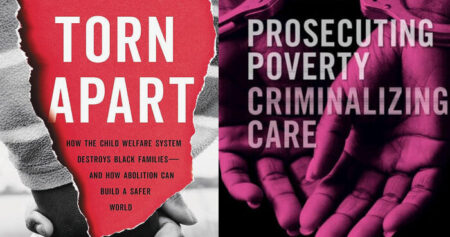
Dorothy Roberts, Wendy Bach, Amna Akbar, & Nancy Polikoff reflect on Torn Apart and Prosecuting Poverty. Plus, Noah Rosenblum on Trump’s plan for the federal bureaucracy, the FTC answers our telemarketing prayers, a special issue on Antitrust in the Age of Concentrated Power, and the JLPE seeks a copy editor.
The carceral state is in a deep legitimacy crisis, with questions about its proper function up for public debate, and social movements pushing for care, public safety, and accountability. Municipalities, meanwhile, are experimenting with non-police responses to varied social problems. These efforts are important: they signal that abolitionist organizing and social insurgency have built sufficient power that the political elite has had to respond. But as Dorothy Roberts and Wendy Bach teach us, care often provides cover for criminalization, and the deployment of professional services often works hand in glove with systems of punishment.
Far from promoting the well-being of children, the so-called child welfare system weaponizes children as a way to threaten families, to scapegoat parents for societal harms to their children, and to buttress the racist, patriarchal, and capitalist status quo. Torn Apart tears off the benevolent veneer of family policing to reveal its political reality and argues that it must be abolished. To achieve this end, we need a paradigm shift in the state’s relationship to families — a reimagining of the very meaning of child welfare.
Neo-Brandeisian and other legal scholars generally associate Brandeis with America’s own anti-monopoly traditions. Yet Brandeis himself drew inspiration from developments unfolding across the Atlantic, and in contrast to Postwar America, where many of his institutional insights were eventually abandoned, the European competition regime has gradually gravitated toward an increasingly Brandeisian approach.
Ntina Tzouvala on the ongoing Afghan central bank saga, Eva Nanopoulos on the contradictions of “peaceful” sanctions, and Aslı Bâli on the parasitic relationship between sanctions and economic asymmetry. Plus, last call to apply to the coolest job in the universe, videos from Money as a Democratic Medium 2.0, the Dig tackles AI, David Dayen on projection at the FTC, Brian Callaci channels AO Hirschman on non-competes, and Brian Highsmith reviews David Schleicher’s In a Bad State.
Humanitarian concerns have generally failed to bring about concrete legal limits on the use of sanctions as a tool of foreign policy. However, as the ongoing saga concerning the Afghan central bank’s assets indicates, they have succeeded in something much more fundamental: they have legitimized the use of sanctions as a tool for undoing and re-assembling the sovereignty of a postcolonial state.