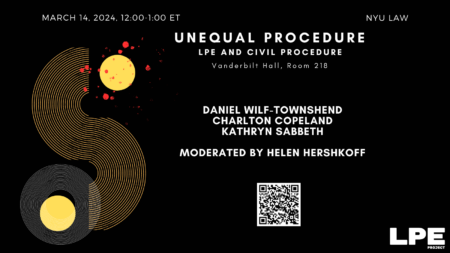
Please join LPE NYC on Thursday, March 14 from 12:00-1:00 ET for Unequal Procedure: LPE and Civil Procedure. Helen Hershkoff will lead a conversation featuring Charlton Copeland, Kathryn Sabbeth, and Daniel Wilf-Townsend on inequality in the various domains touched by civil procedure. The panel will focus on how procedure magnifies and creates inequality, with particular…
This morning, the Supreme Court will hear arguments in the most anticipated cases of the year for the future of regulating tech platforms. While much of the debate will focus on whether the platforms are best analogized to publishers, there is another important argument that the Supreme Court will confront: whether platforms are “common carriers.”
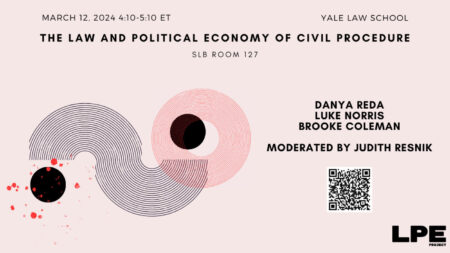
Please join the LPE Project on Tuesday, March 12 at 4:10-5:10 PM ET for The Law and Political Economy of Civil Procedure. Judith Resnik (Arthur Liman Professor of Law at Yale Law School) will lead a conversation featuring Brooke Coleman, Luke Norris, and Danya Reda on developing an LPE approach to civil procedure. The panel…
The Labor and the Law Workshop, co-hosted by the Center for Political Economy at Columbia University, seeks contributions from junior researchers (PhD students and post-doctoral fellows) that address the labor movement’s relationship to the law. Both contemporary and historical approaches to the topic as well as qualitative and quantitative contributions are welcome. We are interested…
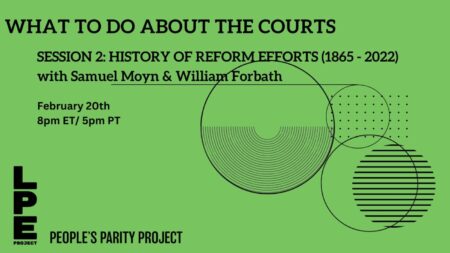
The second session of our 6-part open course/reading group “What To Do About The Courts,” cohosted with the People’s Parity Project, will take place on February 20th at 8pm ET/ 5pm PT. This session will be led by Professors Samuel Moyn and William Forbath. TOPIC: Even though structural and disempowering court reforms are often portrayed as new…
Jed Kroncke on territorial labor in the American Empire, and Megan Wachspress on how workers can divest their labor from war. Plus, the second session of our Courts reading group, a conference on neoliberalism, a cool new job building out the LPE-cinematic universe, and two new pieces on that old chestnut, the State.
In their statement calling for a ceasefire between Israel and Palestine, the UAW International Executive Board raised a tantalizing possibility: What if UAW workers were to divest their labor from the construction of weaponry? Under current labor law, how might workers make their complicity in the military-industrial complex a mandatory subject of bargaining?
Victor Pickard on taking media out of the market, as well as the launch of our hit reading group, What To Do About the Courts. Plus, a feast of upcoming events: Administering a Democratic Political Economy (today!), LPE Night School (Tuesday), Two LPE@HLS event series (on supply chains and social reproduction), a private law series on globalization, RebLaw 2024, a conference on Neoliberalism and Capitalism in Contemporary History, and an LPE in Europe summer academy.
Here’s the terrifying reality: our power-hungry, ultra-conservative Supreme Court will stifle attempts by the government to address climate change, gun violence, racial inequality, and many other pressing problems. Democrats, meanwhile, are unlikely to win back control of the Court until 2065. Given this, it’s past time to take seriously the following question: what to do about the courts? Thankfully, we have just the open course for you.
Brian Callaci on the limits of anti-monopsony antitrust, and Julia Tomassetti on the political economy of employment status disputes. Plus, a call for applications for the 2024 Law and Organizing Academy, T-3 days until the launch of our open course on the Supreme Court, a new podcast on the CIO, a new global LPE syllabus in our syllabus bank, two amici curiae for NetChoice v. Paxton, and new pieces by Moyn-Doerfler, Fernando Quintana, and Charlotte Rosen.
Regulators at both the NLRB and Department of Labor have recently rolled back Trump-era employment status rules. To an outsider, these changes can seem pedantic and inconsequential. A political economy perspective, however, reveals a deeper logic to the new rules, which address three pernicious trends in employment classification — the ability of businesses to manipulate the inherent ambiguity in treating employment like a contract, the ascension of the ideology of human capital, and the norm of the arbitrage economy.
Zohra Ahmed concludes our symposium on non-reformist reforms, and the blog’s editors highlight some of their most anticipated books for 2024. Plus, the launch of What To Do About the Courts, an interview with Corinne Blalock about the left’s ideological infrastructure, an upcoming event with Sanjukta Paul and Nathan Tankus, John Mark Newman on a(nother) recent FTC win, Sandeep Vaheesan on Uber and the failed political economy of the 2010s, and our friends at Just Money kick off a new symposium on the Moral Economies of Money.
The first session of our 6-part open course/reading group “What To Do About The Courts,” cohosted with the People’s Parity Project, will take place on January 30th at 8pm ET/ 5pm PT. This session will be lead by Professor Nikolas Bowie. TOPIC: Over the past few years, the Supreme Court has struck down laws and…
The heuristic of non-reformist reform can help avoid ultra-leftism and create the possibilities for coalition, such as across groups who care about transparency. It can help us salvage the transformative potential of demands that seem to have lost their teeth. But to realize these ends without falling back into reformist pieties, the framework demands rigorous, context-specific thinking that eschews dogmatism.